Fun fact: pull up a search for my name, 百合, on Google, and you get this. Literally translated, Baihe means White Lily. And what did I do today? Went to go look at white lilies.
Calla lilies, to be specific. On a recommendation by a friend of Chialing's, Karina, Analicia and I went up Yangmingshan to see the calla lily fields. The journey there was anything but easy, and may or may not have involved us missing our bus stop and having to walk a couple kilometers down a windy mountain road with no footpath, but eventually we got there. And it was gorgeous!
Our walking route...
The fields had dozens of resident dogs--all black, for some reason. This one was the cutest.
These are, of course, just a few of the many MANY pictures we took up on Yangmingshan. The fields reminded me somewhat of the tulip fields near Seattle: there's just something about row upon row of flowers that is irresistible for photo shoots. We had a lot of fun.
After the lily fields, Karina and I went to meet Tom for dinner--an embarrassing hour-and-a-half later than we said we would, thanks to our bus mishap--and then went back to the hotel to grab our stuff and head home. So our last Taipei trip went much like (one of) our first: a Yangmingshan trip with transportation issues. But this time, unlike our failed summit, we did at least get to see what we came for.
Today was Teachers' Day, which is, as you may have guessed, a day honoring teachers. Apparently there's one in the US, too, but I had never heard of it before 10 seconds ago, when I searched it on Wikipedia. Not possible here!
Here in Taiwan, Teachers' Day is a really big deal--according to Maggie, Kaohsiung used to give teachers $5,000NT each on this day, and according to Alison, they still give New Taipei teachers $1,000NT. (We didn't get money, though, for the record.) Here, Teachers' Day celebrates the attributed birthday of Confucius, he of the hundreds of wise sayings and seemingly the wellspring of all Chinese wisdom. Basically, he's a superstar--and a superstar at teaching. Which means that we, as modern-day teachers, are by extension superstars as well!
Teachers' Day celebrations actually began earlier this week. On Monday, I arrived at Han-Min to find this sitting (not bitten yet, of course; that was me) on my desk:
It's a rice bun filled with red bean and (a single) strawberry! Quite good, actually.
I think it may have been from one of the other teachers or from the administration (all the teachers in the Subject Teachers' Office had one), but still.
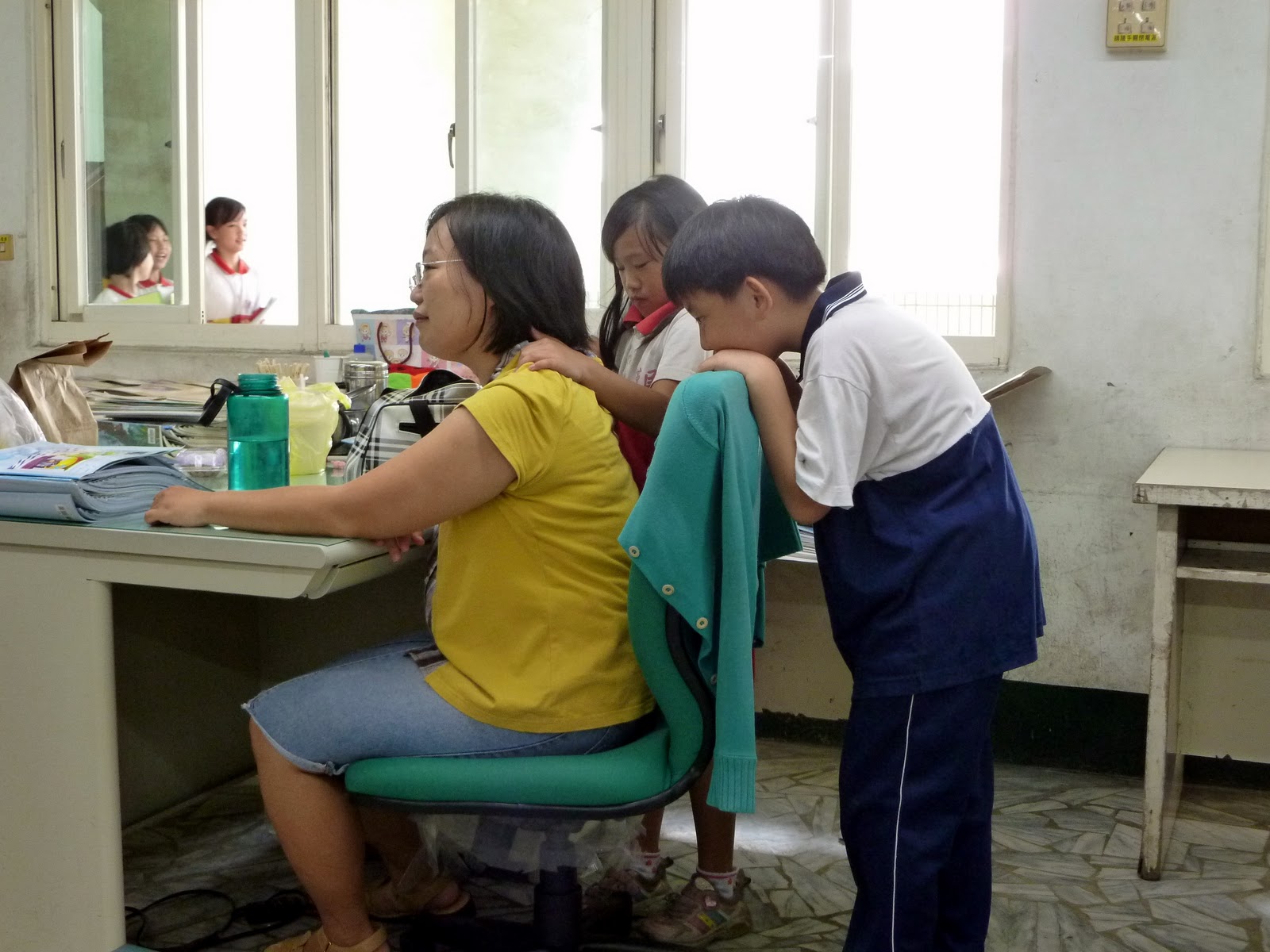
And not to worry: you can't say students don't know how to appreciate their teachers here in Taiwan! Later that day, I witnessed this wonderful little moment:
No, your eyes do not deceive you: that's a student rubbing Alison's shoulders while another waits behind her--they were literally in line a second before I snapped this; a second before that, they were fighting over who got to give her the back rub. Would this happen in America? I think NOT. (Incidentally, the boy in this picture is named Louis; he's a total teachers pet and especially loves Alison. The girl, however, is just there to rub her shoulders.)
And that wasn't even on the day.
Today, after teaching Morning English, I found, first of all, that Alison had bought me coffee. (She is so sweet!) Second of all, I discovered that I, like all other teachers, was a temporary rock star.
(Of course, all it really takes to make me feel like a rockstar is this, but still...)
Anyway, today, in addition to the carefully-scripted "Laoshi hao" and/or "Good Morning Teacher Bekah" in the halls and in the classrooms (where either greeting is accompanied by a group bow), I heard "Happy Teachers' Day!" more times than I could count. And they were genuinely excited about it! This could be evidenced by the growing pile of stuff on my desk that students gave me--I think this was the bulk of it, sans a couple candies I ate.
Worth noting: the flower was from the school
Not pictured is one of my favorite cards, a handmade postcard showing the beach, an umbrella and a big cloud cut out against an inexplicably yellow sky. Actually, now that I'm looking at it again to describe it, you've just got to see it:
Sorry--webcam quality.
I love this card all the more because two girls came literally running up to Maggie and I today while we were on our way to class to deliver it--they were that excited to show us their appreciation. And, terrible teacher that I am (or, you know, just teacher-with-540-students-I-see-once-a-week that I am), I couldn't even tell you their names. I know that they were in class 5-01, so I know I taught them yesterday, and I know that they are super sweet, and made me the best card ever! Yet another reason I need to take individual pictures of my students holding their name cards or something--I can't stand not knowing simple stuff like this!
Aherm--back to topic. Another fun discovery today was that my name has apparently changed its spelling without my knowledge: the standard attempt was "Bkka," which I guess sounds about right if you sound it out, and especially makes sense given that there is no "eh" sound in the Chinese language, but it was a bit funny to see written out over and over.
And once on a crane!
Then there was the absolutely adorable card Alison and I got from a student named Madeline:
Outside...(It reads "Lead; Knowledge; Kind; Humorous; Inspirit; Likes Playing; friend?" Last three are my favorites. :)
And the inside: melts your heart!
But the most extravagant, wow-this-is-fantastic moment came in the second class of the day, when Maggie and I walked in to find...this:
It was beautiful! All over, it read "Happy Teachers' Day" in two languages, plus "I love teacher" and "You are beautiful" in Chinese. I had forgotten my camera, but instantly ran to get it. This was not a board that could be erased before being captured forever!
The artists and their creation.
Had to get a close-up, too, to capture the vividness!
Feeling very honored as a teacher (and very awkward to be having my picture taken--Maggie's idea)
We did, of course, have to erase it for the lesson, but the kids didn't seem to mind. They actually did it themselves, going at it with a gusto I thought amazing, given the time they seemed to have put into making it. But they were enthusiastic, and we then had a great class!
After class: even the home room teacher got in there! Can you spot the adults?
Feeling very blessed to be here in Taiwan, and to have the co-teachers and schools that I do. And not just because they give me stuff on Teachers' Day--they are genuinely some of the best people I've ever met, and I just love spending time with each of them!
I had Chinese class again tonight, and while the hours I put in studying after last week's fiasco definitely paid off, my overwhelming though at the end of class was still one of being overwhelmed. Near the end, Tiffiany began singing this song, and I thought it apt, so I couldn't help but replicate it here:
Congratulations, you will now all have Avril Lavigne stuck in your head for weeks. (Of course, if you're like me and had a younger brother who was obsessed with Weird Al for a while, you may know it better in this form:)
In any case, on the drive home I had both versions playing through my head and alternating between lyrics--with very odd results, I might add. (Though, in my defense, I had forgotten the gross-out lyrics and skipped to the cousin stanza.)
Anyway, back to Chinese. It's complicated! But you know, even its complications are complicated; to be honest, I can't just say it's complicated and leave it at that, because every thing that makes Chinese hard also makes it easy, and vice versa. Check it out:
Hey look, a pros and cons list for learning Chinese!
PRO #1:
Chinese has a limited, and definitive, set of sounds--21 initials, 35 finals. All Chinese words consist of a combination of these, meaning there are really on 411 sound-combinations available in Chinese--infinitely fewer than English, if you think about all the different ways you can combine our 26 little letters (I'm not a mathematician; if anyone wants to tell me how many sound combinations there are in English, feel free. I found my Chinese stats online :) Alternately, of course, you can just pick up a dictionary and see how many unique words you can find in there, but I'm guessing theoretical math is easier in this case..). But 411 sound combinations is puny--anyone should be able to knock through those in no time flat! Which leads us to...
CON #1:
INFINITE HOMONYMS. For the non-grammar-minded among us, a homonym is a word which sounds exactly like another word, but which means something entirely different. In English, these are usually spelled differently, as well; some examples would be heir and air, wood and would, eight and ate--I'm sure you can think of more if you want to. In English, you pick up which homonym is being used by the context--if someone says they're going to give their gold ring to their heir, for instance, you can pretty well guess they mean their next of kin, not the oxygen which happens to be floating past their face. Homonyms are confusing, to be sure, but at least in English, they're a fairly limited set.
Not so in Chinese. As Pro #1 pointed out, in Chinese there are only. 411. Sounds. Possible. Just try listening for context when almost every word is the same. As a result of this homogeneity, in my most recent Chinese unit, for instance, we learned "zai" twice--with the same tone (I'll get to tones in a second--for now, just realize that they're usually what's used to make 411 sounds stretch to fit a language full of words.) So, in the simple question-and-answer of "Where is the post office located?" "Go straight, then turn right," you use "zai" twice, once to mean "located" (郵局在哪裡?) and then to mean "then" (直走, 再右轉.) Even typing those two sentences was difficult--I have pinyin input installed on my computer, so I type each word phonetically and indicate tone by number, yet even so I had to scroll through several pages of choices to find the right characters to use--and not just for zai!
As you can see, the characters for each "zai," 4th tone are different, but that just leads us into our 2nd con...
CON #2: So. Many. Characters. As part of solving the whole every-word-sounds-the-same problem, maybe, Chinese has more than 80,000 characters; you need to memorize at least a few thousand to be considered literate in the language. According to Wikipedia, educated Chinese-speakers know 4,000. Wait, 4,000? Out of 80,000? And these are the educated people??? Annnd here we run into how very very difficult and--wait for it--COMPLICATED the Chinese language truly is. It's not unimaginable at all for a very well educated Chinese-speaking person to run across completely unknown characters while reading something slightly more obscure. Sure, this happens to English-speakers, too, but at least with a phonetic language and a basic knowledge of linguistic etymology (such as the educated person in our scenario would have), you would have a pretty good shot at pronouncing it at least in the ballpark of correctly. Not so in Chinese-- from what I can tell, at least, a new character is a new character: you may be able to derive the meaning from the radicals (patterns based on meaning which get repeated across characters), but there's absolutely no guarantee that you could pronounce it. Maybe that's just my flawed understanding of the language, but so far as I can tell, that's it: a new character is absolutely unknowable, even for a very educated person. So good luck when you run into those lesser-used 76,000 words, I guess.
But at least you know to expect them. Which brings us to...
PRO #2: You can't change the characters. No, really, you can't change them. So, you know that whole irregularity thing you get in most languages, things like verb conjugations, pluralizations, all that crap? Throw it out the window. A word is a word is a word. "I go" is the same as "He goes" is the same as "She goes" is the same as "They went." (Man, where did English come up with those screwy changes, anyway? "Go" to "went"? Almost as bad as Spanish's "voy" to "fuí," from a verb called "ir." Almost.)
It's kind of refreshing in Chinese, coming from a language chock full of verb- and tense-confusion and irregularities: suddenly, "I go to the beach;" "Yesterday I go to the beach;" and "Tomorrow, he and I go to the beach" are all perfectly correct. Lovely for a new learner, especially when there are so many/so few words to work with all of a sudden. Just add a modifier like "de" (的) to most anything and it's possessive/adjectival (我 is "me/I," 我的 is "mine;" 中山路 is "ZhongShan Road," 中山路的 is "on ZhongShan Road"); add "le" (了), or just specify a time like yesterday, and you've made it past tense. And that's glorious.
And another glorious fact brought about by unchanging characters is...
PRO #3: They started combining words to make more words--and their compound words actually make SENSE. This is actually probably the single best thing about Chinese: if you know what each of the characters in a compound word means, you can probably figure out what the word means as a whole. Conversely, if you have absolutely no idea what the word you're searching for is, you can talk your way around the unknown word and, chances are, you might actually hit on the right one. As an example, the other day Rachel and I went out looking for a helmet store; on the way there, Rachel (who actually knows Chinese, unlike me) told me she didn't know the word for helmet, but she knew the words for head, scooter, safety, and thing. So, the plan was to ask if they had any "scooter head safety things." And sure, that strategy might also work in English, but the likelihood of actually guessing the word in English is infinitely smaller than in Chinese.
I mean, come on, just look at English compound words. There's neither "pine" nor "apple" in a pineapple, for instance. Chinese is much more sensical: the word for "school," for instance, "學校," is literally "study school;" an elementary school is "小學校," or "small study school;" and college is "大學," or "big study." As a language learner, there's no way not to love how literal it can be.
BUT...
PRO/CON #4: It's ironic that this is my fourth and last pro/con--and odd for me that I even have a fourth point--because what I'm going to talk about here is TONES, and there are four regular tones in Chinese (technically 5, but the 5th is a non-tone). And I don't quite know where to stick them.
On the one hand, tones are great--they provide a great non-context way out of the sticky homonym situation, and they make you sound super animated all the time.
But on the other hand, they're terrible--for English-speakers who are used to infusing our daily speech with tone to convey emotion, not meaning, the prospect of accidentally putting that question-mark tone (the 2nd tone in Chinese sounds like us asking a question in English) on a word accidentally, AND CHANGING THE ENTIRE MEANING OF THE WORD, is terrifying. Take the seemingly innocent and wonderful word "love"--in Chinese, pronounced "ai" (as in "eye;" 愛), with the fourth tone (which goes down from high to low, and sounds like a very serious definitive--not very loving in English). BUT the 4th tone is absolutely crucial here. Say "ai" with a first tone (like singing) and it means "sorrow;" with a second tone (question mark) and it means "cancer;" with a third tone (dropping and rising) and it means "low."
And that's just one example--and, for that matter, just one set of what each of those tones can mean, because, as I mentioned earlier, the same sounds and the same tones can have different meanings. Just, you know, for fun.
Maybe I do know where to stick tones--in the "cons" category. Because no one wants to accidentally tell someone that they "sorrow" them.
So yeah, that's my pros and cons list. I'll likely add more as I learn more, but now I'm still at an extremely low level of study. How low, you ask? Well, today during my breaks at Han-Min I was studying the words 圖書館 (library), 花店 (flower shop), and 銀行 (bank), amongst others, at my desk--and all three of those words were in our lesson for the 6th graders today. What's more, most of them were able to volunteer other locations when prompted, places like the swimming pool or the department store. I don't know how to say swimming pool.
But I'll learn! Because, for all its complications, Chinese is worth it, and I'm loving growing in my knowledge of it daily, however slowly.
We went to on more school visits today, to Dashe, Dashu, and to Meinong, where one ETA will be living alone.
First of all, it is ABSOLUTELY gorgeous out there. I mean really, really gorgeous. I still want to live in the city, but I wish I could visit once a month, or something...Check it out.
In Meinong, at the paper umbrella festival!
Looking around the school...
...yeah, it's beautiful
We had a lot of driving to do. First, we drove from our apartment in the center of the city to Dashe, on the outskirts of the city; then to Dashu, out in the countryside, next to the largest Buddhist temple in Taiwan; then to Meinong. I know I keep repeating it, but it is absolutely gorgeous out there--green mountains shrouded in mist, vibrant tropical flowers sprouting randomly from trees, water lilies floating on ponds, absolute silence--it was idyllic; definitely one of the most beautiful drives I've ever been on.
But I don't want to have to make it on a regular basis. Still, I think all of us who went lost a little of our heart there, and it will definitely make it easier on whomever ends up there. It seemed super homey and livable, and the people are all really nice and friendly. So this trip definitely helped.
Another major highlight of the day was getting to paint paper umbrellas at the paper umbrella festival in Meinong! Apparently, Meinong is world-famous for their paper umbrellas--check it out here.They were having an umbrella-painting competition while we were ther--check out the room full of submissions!
Here's the one I painted. The characters are my name in Chinese, Baihe, (pronounced Bye-huh; it means "Lily" in Mandarin), which all the Meinong citizens loved!